Dolmenwolves Campaign
After way too long I decided it was time to run a new campaign.
The thought first came to me while cooking up a variant for better handling a calendar and faction turns. I wanted to try it out before foolishly blasting it out to the world like a cocky blogger. Most of my non theory posts spring directly from things I actually tried in my games anyway.
So I started a one hour lunchbreak game in Dolmenwood. Then enough people were interested that it turned into two groups, playing on different days in the same world, starting in different hexes and knowing nothing about each other except that another group exists. I hope this creates some fun chaos down the line.
Dolmenwood makes things easy for me. Having run two campaigns there before, I don't really need to dive into its factions again. I feel I know them well enough to quickly come up with interesting powder keg situations. To make it interesting for myself I changed systems again and put together a basic hack of Wolves Upon the Coast.
My tendency otherwise is to work long and hard on tiny things until I no longer have the energy to actually organize a game.
The games that have worked best for me were the ones where I jumped in after some broad scaffolding and just went for it. Everything else I can figure out once the game exists. Playing is the best source of creative inspiration anyway.
So that's the plan basically. Two groups playing short sessions in one Dolmenwood, with time and factions moving around them whether they're there to see it or not. Here is the work so far.
The Setup
I'm running one hour sessions, which I've recently enjoyed very much as a player and which I can actually fit into the middle of the day. My players also span the globe, so timezones can actually be a friend if you play online during the day.
The two groups are playing in the same world. They started in different locations, but actions from one group can cascade outward and eventually affect the other. This does mean I need to keep strict time records, which means more calendar play (yay!). It would even be possible for the groups to meet.
This happened recently in Hawk's awesome Hot Snack Island game. I imagine something similar would be doable here, maybe played out via text.
BUT let's see if that actually happens.
Dolmenwood is much bigger than HSI and their timelines could get wildly out of sync. One group might spend days travelling while the other crawls a dungeon or takes downtime, or one group wanders into Fairy and comes back 3 weeks later.
We all hang out on the same Discord, with private channels for each group and shared channels for rules and rulings. Character sheets and group notes live in HackMD, and we're using tldraw for mapping and a shared whiteboard.
The Rules
I put together a simple Wolves Upon the Coast hack in about a day or two. The goal was to have something playable before I had time to overthink it. The rules aren't extensive anyway, so I kept most of them and changed a few things to make them more Dolmenwood.
The biggest rules change is that Boasting is gone and replaced with two systems inspired by (or lifted hehehe) Luke Gearing's Obligations and Valeria's Promises.
Advancement A character may benefit from one Promise and one Obligation at the same time.
When HD is gained, roll all the character's HD. If the total is higher than their current maximum HP, this becomes their new total. Otherwise add +2 to their current maximum HP. Improving a Save reduces its target by 1.
Promises A character who makes a Promise of Heroic Proportions gains either 1 HD or +1 Attack Bonus in addition to any wager or reward offered by others. A Promise must be made to another person or group and must matter to them. It cannot be routine or easily accomplished. If they are found to shirk their Promise, they lose the advancement and may never again make a Promise. Those genuinely attempting and failing the Promise lose the advancement, but may make another Promise.
Obligations A character who accepts a significant ongoing Obligation gains either 1 HD or improves one Save by 1. An Obligation is a duty the character has taken on and cannot freely ignore. It must be able to make demands that interfere with the character's own plans. If it asks nothing of them, it grants nothing. The advancement remains while the Obligation is honoured. Neglecting or betraying it causes the advancement to be lost.
They're obviously subject to change after some actual play.
I made this change because I want relationships with communities, factions, and NPCs to matter more. I'm leaning toward political play, and both Promises and Obligations require someone in the world to actually accept those terms.
There is a big caveat though. Boasting lets players set advancement goals almost entirely by themselves. Promises and Obligations still let them set their own goals, but now they need NPCs to anchor those goals in the world. That also means making advancement claims becomes harder when you're out in the wilderness or deep in a dungeon. That's by design, but idk yet if it's smart. I like Promises and Obligations because they feel like something you'd do in this kind of feudal society with knights and shit, but also something you'd do with fairies or chaos godlings.
If it ends up too limiting I might bring Boasting back. I still like it as self driven, autonomous goal setting that's effectively peer reviewed. Actual play will tell me.
One thing I added from Dolmenwood are the Kindred. I'm not the biggest fan of them but they are part of the Dolmenwood experience. I didn't want big Kindred abilities, but they should still feel different somehow. Diegetically they already are. NPCs should react very differently to them, but that's exactly the sort of thing that's easy to forget in the heat of a session.
I wanted character creation to stay fast. So you choose a Kindred and roll on its Background table. Each Kindred gets a fairly different set of 20 entries describing what you did in your past life. The Dolmenwood Player's Book already has tables for this but, to be fair, I didn't like a lot of the entries. So I took the ones I liked and added more. If you roll something like marriage broker or midwife, that immediately makes you wonder how this could actually be useful and influential for your character.
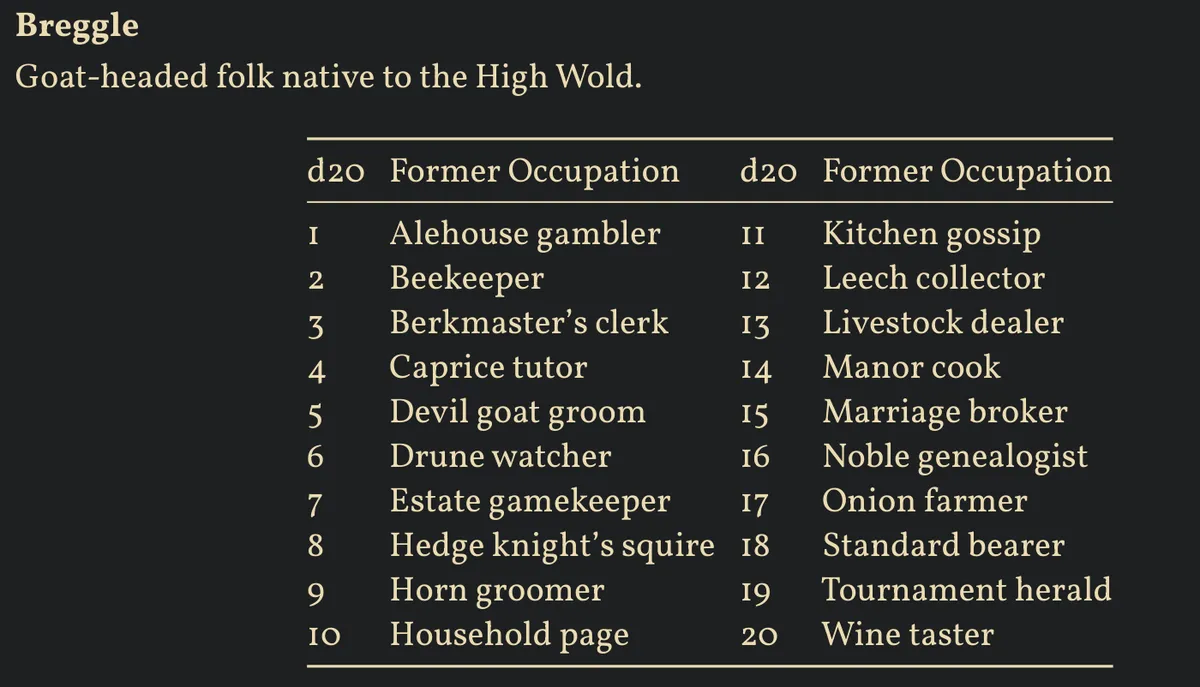
Languages are another small way Kindred choice matters. They work the same as in Wolves, except you choose them at the beginning of play. No quantum languages. I keep the half-known / fluent / literate setup. Everyone starts with Woldish at half-known, except humans who are fluent, and each Kindred starts fluent in their native tongue. So yea, if you want to look at it in the most min-max optimizer way possible, non-humans get slight edge here. Whatev.
I tried making the backgrounds more elaborate and realized I was accidentally building a lifepath system. If I'm going to do that, I'd rather make an actual Traveller-style lifepath where character creation itself is part of the game and lets you make decisions rather than just roll on tables. That was wildly out of scope, and I prefer simple.
So it's simple backgrounds because Wolves already slaps. And when in doubt, when even just bears fails me, I can always just give someone Hit Dice and that's basically it, usually.
Everything else I changed is minor. Some extra equipment, shopping-list stuff and little Dolmenwood-specific bits, but it's still like 90% Wolves. If something is broken I'm confident I can make it work with my players. Believe that what you know is enough. The rest can become a problem when it actually becomes a problem.
Perfection is the play-killer.
The Prep
There was one other thing I changed, though it's really more of a campaign start procedure. Wolves starts you off with a boat and a bunch of NPCs who are basically your crew after you killed your former master. That's a great start. But not how I'd start Dolmenwood.
In the kind of player-driven sandbox I'm running there are roughly 4 big game loops: dungeon crawling, wilderness travel, settlement play and downtime. So I wrote one starting scene for each and let the players pick. Rather than asking everyone abstractly what kind of game they wanted, they could just choose what they wanted to do first.
Choose one to start
You were paid to recover something from inside a barrow. The man who hired you died on the road. The door is open. Whatever lies below is now yours to reckon with.
You left the road yesterday. Night is coming and you are no longer sure which way leads home. Something in the Wood has found you.
You were carrying something valuable to a nearby settlement. It is gone. Someone died over it. The people waiting for you still expect an answer.
You returned from the Wood with more gold than you left with. There are debts to pay, things to buy, and people suddenly interested in you. You also know where more lies.
To no one's surprise, both groups heavily favored the dungeon option. So my prep was basically deciding where each group would start and picking a dungeon for them. Since I already know Dolmenwood well enough, I didn't need to spend much time prepping factions or reading up on things. That left me time to make some actual content.
For one group I took a fairly popular official dungeon and restocked it, so even somebody who knows it won't know exactly what's inside. For the other I took the bones of a non Dolmenwood dungeon and changed it heavily to fit.
This is likely a me thing, but I heavily dislike dicing together random modules just because they're loosely related in theme. If you're not careful, you get contradictions in the setting or, worse, little capsule locations that have nothing to do with the world around them. I like my stuff integrated. Making it fit takes some effort, but honestly not as much as people sometimes think. Once the players are through the dungeon I'll write about what I changed and why.
And that's basically the prep. Two dungeons, a calendar, and some factions already doing things in the background.
We just finished the first week of sessions. No one has made any Promises yet, but events are already beginning to pile up on the calendar. Now I get to find out whether all this actually works. More once we've played some more.
I'm also making way more stuff than I actually need because dang, this campaign is inspiring as hell.
I started cooking up magic systems and have fallen down the monsters& and &&&&&&&&&treasure hole, having a blast converting things. None of it is necessary, which makes it an even better creative outlet.